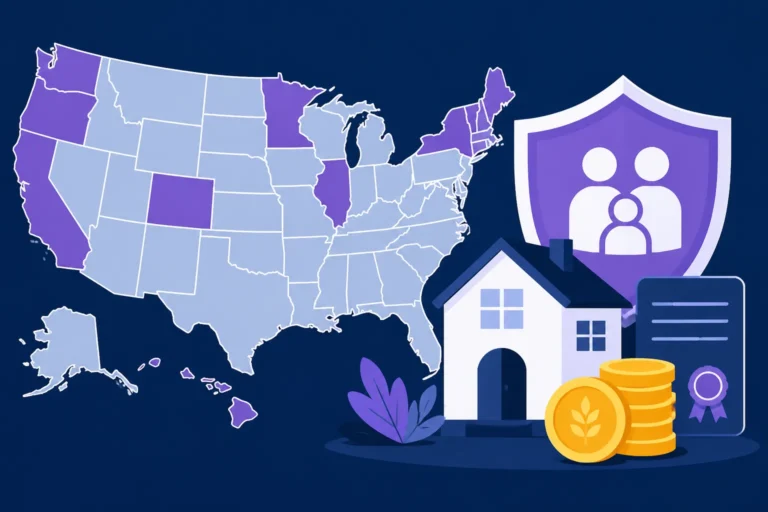
Hawaii Estate Tax Exemption 2026
Losing a multi-generational family home in Honolulu because of a sudden, massive tax bill is a nightmare many Hawaii families quietly fear. This guide breaks down the Hawaii Estate Tax Exemption 2026, helping you navigate the island's unique tax rates, the "trap" of non-portability, and specific strategies to ensure your hard-earned assets stay with your loved ones rather than the state government.
Hawaii Estate Tax Exemption 2026: The Reality for Island Families
For many people living in the mainland, an estate tax feels like a "rich person problem." But here in Hawaii, the skyrocketing cost of real estate has changed the math for everyone. When a modest three-bedroom home in a neighborhood like Manoa or Kailua can easily clear $2 million, it doesn't take much more—a life insurance policy, a 401(k), and some savings—to push a local family into the taxable zone. As we look toward 2026, the Hawaii estate tax exemption is expected to remain around the $5.49 million mark, though it is technically indexed for inflation based on the 2017 federal levels.
The frustration I hear most often from local families is that the state government seems to be punishing them for simply owning a home that happened to appreciate over forty years. You’ve worked your whole life, paid your property taxes, and now, at the moment of passing, the state wants another 10% to 20% of what’s left. It feels like a "paradise tax" that never ends. Understanding the Hawaii Estate Tax Exemption 2026 is the first step in making sure you aren't caught off guard. While the federal exemption is set to drop significantly in 2026 due to the sunsetting of the Tax Cuts and Jobs Act, Hawaii’s state-level exemption operates on its own track, creating a confusing "double standard" for many taxpayers.
If you are trying to get a rough idea of where your estate stands today, using a tool like SmartAsset can help you visualize the potential hit. When you look at the list of Which States Have an Estate Tax in 2026?, Hawaii consistently stands out not just for having the tax, but for having some of the highest rates in the nation. It is a sobering reality that requires proactive planning, especially if your primary asset is the land your family has lived on for generations.
Why Real Estate Prices Make This a Middle-Class Issue
In most of the country, a $5.49 million exemption covers 99% of the population. In Hawaii, the "Ohana" wealth tied up in real estate makes this threshold much more dangerous. I’ve seen cases where a family owned a small plot of land on Maui that was passed down from a grandparent. Suddenly, because of the surrounding development and the surge in tourism-driven property values, that "simple" plot of land is valued at $4 million.
When you add in the question, Does Life Insurance Count Toward Estate Tax?, the answer is often a resounding yes. If you have a $1 million policy to take care of your spouse, that policy is added to the value of your home and your bank accounts. Suddenly, you are over the $5.49 million limit without even trying. This isn't just about high-net-worth individuals; it’s about anyone who has managed to build a stable life in the islands.
The Inflation Gap and the Horizon
One of the biggest gripes with the Hawaii system is how the exemption is indexed. While it is supposed to keep pace with inflation, it often feels like it's lagging behind the actual cost of living in the islands. By the time 2026 rolls around, $5.49 million might buy significantly less than it did a decade ago, yet the tax threshold hasn't moved upward in a meaningful way to protect families.
Many residents are surprised to learn that Hawaii is one of only a handful of states that still maintains a separate estate tax. When you compare State Estate Tax Exemptions & Rates Compared 2026, you’ll see that Hawaii's top rate of 20% is tied with Washington for the highest in the country. It’s a steep price to pay for the privilege of leaving an inheritance in the Aloha State.
Calculating Your Potential Hawaii Estate Tax Bill
Understanding the math behind the tax is where things get truly stressful. Hawaii uses a progressive tax rate, which means the more your estate is worth over the exemption, the higher the percentage you pay on those "excess" dollars. The rates start at 10% and climb quickly to 20%. This is why it’s so important to know exactly Hawaii Estate Tax: Who Pays & How Much. It isn't a flat fee; it’s a sliding scale that can take a massive bite out of a family’s liquid cash.
Imagine a scenario where a local business owner passes away with an estate valued at $7 million. After taking the $5.49 million exemption, they are left with roughly $1.51 million in "taxable" estate. At the Hawaii rates, the state could be looking for a check for nearly $200,000 within nine months of the death. For many families, that money isn't just sitting in a savings account—it’s tied up in the business or the family home. This often forces the sale of assets just to pay the tax bill, which is the exact opposite of what most people want for their heirs.
If you’re feeling overwhelmed by these numbers, consulting a resource like SmartAsset can provide a baseline for your specific situation. You need to be asking yourself, What Assets Are Included in Your Estate?. The list is long: it includes your home, your cars, your jewelry, your retirement accounts, and even your business interests. Every dollar counts toward that $5.49 million ceiling.
Understanding the Progressive Rate Structure
The Hawaii tax brackets are tiered. The first $1 million over the exemption is taxed at lower rates (10% to 14%), but once you get beyond that, you hit the 15.7%, 18%, and eventually the 20% mark. This creates a "bracket creep" effect where a slightly larger estate doesn't just pay more tax—it pays a higher percentage of tax.
This is particularly painful for those who own out-of-state property. If you have a condo in Las Vegas or a rental in California, Hawaii will look at your "total" global estate to determine your tax rate, then pro-rate it based on the Hawaii-situs property. It’s a complex calculation that often requires a specialized accountant to navigate correctly.
The Role of Out-of-State Property and Non-Residents
Many people move to Hawaii for retirement but keep their property back on the mainland. Or, conversely, they own a vacation home here but live in a state like Florida. If you are a non-resident owning property in Hawaii, you don't get the full $5.49 million exemption. It gets "apportioned." This means if only 20% of your assets are in Hawaii, you might only get 20% of the exemption applied to those assets.
This "gotcha" catch is why so many part-time residents find themselves owing money to the Department of Taxation. If you’re curious about how this stacks up against federal rules, looking into State vs Federal Estate Tax: How They Stack is essential. You could owe nothing to the IRS but still owe hundreds of thousands to Honolulu.
| Estate Value | Estimated Hawaii Tax (Over $5.49M Exemption) | Top Marginal Rate |
|---|---|---|
| $6 Million | $51,000 | 10% |
| $7 Million | $162,000 | 12% |
| $8 Million | $302,000 | 14% |
| $10 Million | $622,000 | 16% |
| $15 Million | $1,572,000 | 20% |
Why Hawaii's Lack of Portability Is a Trap
This is the part of the conversation where people usually get angry. At the federal level, there is something called "portability." This allows a surviving spouse to "inherit" the unused portion of their deceased spouse's estate tax exemption. If a husband dies and only uses $2 million of his exemption, the wife can add his remaining $11+ million to her own. It’s a great safety net for married couples.
Hawaii, however, does not offer portability. This is a massive planning failure for many couples. If you haven't structured your estate correctly, you could lose half of your family's potential exemption. This is why understanding Estate Tax Portability and Why Most States Don't Offer It is so critical for Hawaii residents. Without portability, a couple effectively has a "use it or lose it" situation for the first spouse to pass away.
Let’s look at a realistic example. "Kanoa and Leilani" have a combined estate of $8 million. They assume that because the exemption is $5.49 million, they are fine as a couple ($5.49M x 2 = $10.98M). However, Kanoa dies first and leaves everything directly to Leilani. Because Hawaii doesn't have portability, Kanoa’s $5.49 million exemption essentially vanishes. When Leilani later passes away, her estate is now worth the full $8 million, but she only has her $5.49 million exemption to apply. Her children will now owe Hawaii tax on the $2.51 million difference. This is a completely avoidable tax bill that costs local families millions every year.
The "Use It or Lose It" Exemption Strategy
To fix this, Hawaii couples often use "Bypass Trusts" or "Credit Shelter Trusts." Instead of leaving everything directly to a spouse, the first spouse's assets (up to the exemption amount) go into a trust. The surviving spouse can still use the money and live in the house, but those assets are "locked in" using the first spouse's exemption.
This ensures that when the second spouse passes, those assets aren't counted as part of their estate. It’s a bit more paperwork, but it’s the only way to effectively "port" the exemption in a state that refuses to do it automatically. If you’re looking for a deeper dive into this, you should read our full Hawaii Estate Tax Guide 2026.
Comparison with Federal Estate Tax Rules
The contrast between state and federal rules is going to get even sharper in 2026. While the federal exemption is expected to drop to around $7 million (adjusted for inflation), it still allows for portability. Hawaii’s lower threshold and lack of portability create a "perfect storm" for those with assets between $5 million and $10 million. You might be perfectly safe from the IRS but completely exposed to the Hawaii Department of Taxation.
It is wise to use a site like SmartAsset to keep an eye on these shifting thresholds. Being proactive is the only way to avoid the trap. If you don't have a trust in place by 2026, you are essentially gambling with your heirs' inheritance.
Proactive Steps to Minimize Your Hawaii Estate Tax
The good news is that Hawaii is a "no gift tax" state. This is the biggest loophole available to you. While the federal government tracks every dollar you give away over your lifetime, Hawaii does not have its own separate gift tax. This means you can reduce the size of your estate by giving money to your children or grandchildren while you are still alive, and Hawaii won't take a cut of that gift.
If you're wondering How to Avoid Estate Tax in Hawaii, gifting is often the most straightforward answer. If you are sitting at a $6 million estate and you’re worried about that $5.49 million cliff, you could theoretically gift $600,000 to your heirs today. This brings your estate down to $5.4 million—below the taxable threshold. You get to see your family enjoy the money now, and you save them a massive headache later.
However, you have to be careful about the "three-year rule." Hawaii, like many states, has a "contemplation of death" provision. If you make massive gifts and then pass away within a short window (usually three years), the state may try to "pull" those gifts back into your estate for tax calculation purposes. It’s a sneaky rule that catches people who wait until the last minute to plan.
Life Insurance and Hawaii Tax Planning
Many people don't realize that they can remove life insurance from their taxable estate by using an Irrevocable Life Insurance Trust (ILIT). If the trust owns the policy, the payout isn't counted toward your $5.49 million exemption. This is a huge win for families who have large policies intended to provide for a surviving spouse or pay for a child’s education.
When people ask, How to Avoid Estate Tax in Hawaii, they are often looking for a "magic bullet," but it’s usually a combination of small moves. Gifting, setting up the right trusts, and ensuring your life insurance is structured correctly are the keys to staying under the radar.
The Importance of Early Appraisals
One final tip: get your property appraised now. If you think you are close to the limit, knowing the "date of death" value is vital, but having a baseline today helps you decide how much you need to gift. Hawaii’s Department of Taxation is notoriously thorough when it comes to real estate valuations. They aren't going to just take your word for it—they want professional appraisals.
By taking these steps before 2026, you are taking control of your legacy. You’ve worked hard for what you have; don't let a lack of planning turn your "Aloha" into a "Goodbye" to your family's wealth.
Hawaii Estate Tax Disclaimer
The information provided in this guide is for educational and informational purposes only and does not constitute legal, financial, or tax advice. Estate tax laws, particularly in Hawaii, are subject to frequent changes, legislative updates, and varying interpretations by the Department of Taxation. The 2026 exemption amounts and rates mentioned are based on current projections and historical data and may be adjusted by state or federal authorities. Always consult with a qualified estate planning attorney or a certified tax professional who is licensed in the State of Hawaii before making any decisions regarding your estate plan or tax strategies. Reliance on any information provided in this article is solely at your own risk.